Illinois-Specific Data: Why These Initiatives Matter Here

Scope of Need in Illinois
In Illinois alone:
- Over 1.5 million individuals live with a disability, with approximately 5.4% of the population having a developmental disability
- More than 16,000 individuals are currently enrolled in the PUNS (Prioritization of Urgency of Need for Services) list, waiting for services
- Thousands of individuals remain unserved or under-supported, often relying on aging caregivers
This means a large portion of the IDD population is either:
- waiting for services
- receiving limited support
- navigating systems that are already strained
High Medical and Support Needs
llinois data shows that individuals in IDD systems often have complex and high-risk needs:
- 40% require extensive personal care and constant supervision
- 20% are classified as having high or highest health risk levels
- A significant portion of individuals in state-operated settings have co-occurring psychiatric conditions (over 50%)
These are not low-support populations—they require:
- accurate medical assessment
- coordinated care
- highly trained providers
Evidence of System Risk & Mortality Concerns
Illinois-specific research highlights serious safety concerns:
- In one state review, 63 individuals with IDD died within a defined period across state-operated settings and transitions
- Individuals who died often had:
- high health risk scores
- extensive care needs
- long-term system involvement
This reinforces a key issue:
Those with the highest needs are also the most vulnerable to system failure.
Service Gaps and Workforce Challenges
Illinois’ system is under strain:
- Only ~2% of caregiving families receive state-funded support
- Illinois ranks 45th in the nation for competitive employment outcomes for individuals with IDD
- Significant workforce and funding gaps impact quality of care and oversight
These gaps directly affect:
- response time to medical concerns
- quality of assessment
- consistency of care
Why This Matters for Medical Safety
When you connect all of this:
- High medical complexity
- Limited system capacity
- Long waitlists
- Workforce shortages
You get increased risk for exactly what your initiative addresses:
- Diagnostic Overshadowing
- Missed or delayed medical care
- Over-reliance on behavioral expectations
- Preventable health decline or death
Data Sources & Research References
- National Association of Councils on Developmental Disabilities. (n.d.). Illinois state profile. https://nacdd.org/state-profiles/illinois/
- The Institute on Public Policy for People with Disabilities. (2025). Illinois IDD services by the numbers. https://www.instituteonline.org
- University of Illinois at Chicago, Department of Disability and Human Development. (2018). Evaluation of the transition of individuals with developmental disabilities from state-operated developmental centers (SODCs). https://eppu.ahs.uic.edu
- Illinois Department of Human Services. (n.d.). Prioritization of urgency of need for services (PUNS). https://www.dhs.state.il.us
- Illinois Council on Developmental Disabilities. (n.d.). Data and reports on disability services in Illinois. https://icdd.illinois.gov
- Krahn, G. L., Hammond, L., & Turner, A. (2006). A cascade of disparities: Health and health care access for people with intellectual disabilities. Mental Retardation and Developmental Disabilities Research Reviews, 12(1), 70–82. https://doi.org/10.1002/mrdd.20098
- National Core Indicators. (2023). In-person survey report: Illinois. https://www.nationalcoreindicators.org
- U.S. Department of Health and Human Services. (2022). Health disparities among individuals with disabilities. https://www.hhs.gov
Scope of Need in Illinois
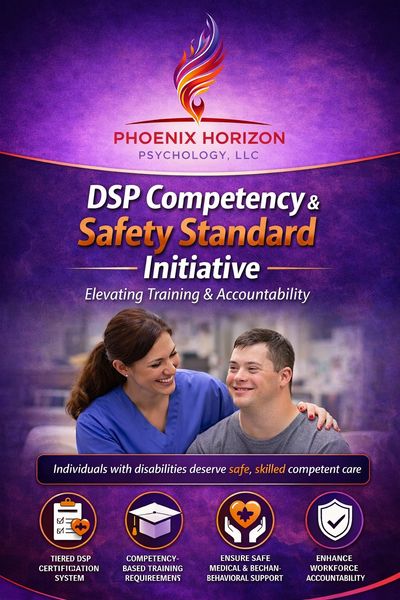
In Illinois and across the U.S., Direct Support Professionals (DSPs) are the primary providers of daily care for individuals with intellectual and developmental disabilities.
However:
- The IDD service system relies on a workforce that is chronically understaffed and under-resourced
- DSP roles often require managing:
- complex medical conditions
- behavioral challenges
- crisis situations
Despite this level of responsibility:
- There is no universally enforced, competency-based certification standard across providers
- Training requirements vary widely depending on agency and setting
This creates inconsistency in care quality and safety across the system
Workforce Instability & Turnover
Workforce data shows significant instability:
- DSP turnover rates nationally range from 30% to over 50% annually
- The average turnover rate is approximately 37% across states
- Vacancy rates remain high, leading to:
- understaffed homes
- increased reliance on overtime and temporary staff
High turnover results in:
- lack of continuity of care
- reduced familiarity with individual needs
- increased risk of errors and incidents
Impact on Health & Safety
Research directly links DSP workforce instability to safety outcomes:
- Higher DSP turnover is associated with:
- increased emergency room visits
- higher rates of abuse and neglect
- more frequent injuries
- Individuals supported by less experienced or inconsistently trained staff are more likely to experience:
- missed medical concerns
- delayed response to health changes
- improper implementation of care plans
This reinforces a key issue: staff competency is directly tied to individual safety and health outcomes
Training Gaps & Inconsistency
Current training systems often emphasize completion over competency:
- Many DSPs receive:
- orientation-based training
- limited hands-on skill validation
- Critical areas are often underdeveloped:
- medical emergency recognition
- distinguishing behavioral vs. medical symptoms
- trauma-informed care
- communication across care teams
Without competency validation, staff may be technically trained but not practically prepared.
System-Level Challenges
Illinois faces broader structural issues impacting DSP effectiveness:
- Workforce shortages limit:
- supervision
- ongoing training
- quality assurance
- Funding constraints impact:
- wages
- retention
- investment in training systems
- Lack of standardized tracking means:
- no centralized way to monitor competency
- limited accountability across providers
These gaps contribute to inconsistent care and preventable risk.
Why This Matters for Safety
When you connect all of this:
- High workforce turnover
- Inconsistent training standards
- Lack of competency validation
- Limited oversight and tracking
You get increased risk for:
- Medical emergencies being missed or mismanaged
- Behavioral plans being implemented incorrectly
- Delayed or inappropriate responses to crisis situations
- Increased likelihood of neglect (intentional or unintentional)
Connection to System Reform
The DSP workforce is not just a staffing issue—it is a core driver of system safety and quality.
Without a standardized, competency-based approach:
- Even strong policies cannot be implemented effectively
- Individuals remain vulnerable to inconsistent care
- Providers struggle to maintain safe and stable environments
Strengthening DSP competency is essential to improving:
- medical safety
- care consistency
- overall system accountability
Data Sources & Research References
- National Core Indicators. (2024). State of the Workforce Survey Report.
https://idd.nationalcoreindicators.org - PHI. (2023). The impact of direct support professional turnover on the health and safety of people with intellectual and developmental disabilities.
https://www.phinational.org - Friedman, C. (2018). The impact of direct support professional turnover on the health and safety of people with intellectual and developmental disabilities. Intellectual and Developmental Disabilities, 56(4), 275–285.
- Bogenschutz, M. D., Hewitt, A., Nord, D., & Hepperlen, R. (2014). Direct support workforce supporting individuals with IDD: Current challenges and future directions.
- Hewitt, A., et al. (2023). State of the Direct Support Workforce and System Performance.
- U.S. Bureau of Labor Statistics. (2023). Home health and personal care aides workforce data.
https://www.bls.gov - National Alliance for Direct Support Professionals (NADSP). (n.d.). DSP workforce crisis and competency framework.
https://www.nadsp.org
Scope of Need in Illinois
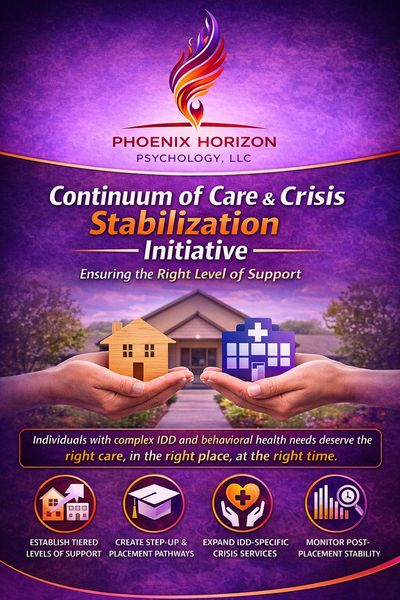
In Illinois, individuals with intellectual and developmental disabilities (IDD) often require varying levels of support over time, including periods of increased medical or behavioral need.
However, the current system is heavily structured around fixed placement models, primarily community-based settings such as CILAs.
At the same time:
- Over 16,000 individuals remain on the PUNS waitlist, limiting access to appropriate services
- Many individuals already in services have:
- complex medical needs
- co-occurring mental health conditions
- Families and providers report limited options when needs exceed current placement capacity
This creates a system where individuals are often expected to fit the placement, rather than the placement adapting to the individual
High-Acuity Needs & Crisis Risk
Illinois data and national research indicate:
- A significant portion of individuals in IDD services:
- have co-occurring psychiatric conditions
- require intensive behavioral and medical supports
- Behavioral health crises among individuals with IDD:
- are often misunderstood or mismanaged
- may escalate due to lack of appropriate intervention settings
Individuals with higher needs are at increased risk for:
- placement instability
- hospitalization
- system cycling between services
Placement Instability & System Gaps
Current system limitations contribute to placement challenges:
- Community providers may lack:
- staffing capacity
- clinical resources
- specialized training
- When placements begin to fail:
- there are limited structured pathways for escalation of care
- decisions are often reactive rather than proactive
This can result in:
- repeated hospitalizations
- emergency room utilization
- involvement with crisis systems not designed for IDD populations
Limited Crisis Stabilization Infrastructure
Illinois has begun developing IDD-specific stabilization homes, but:
- Availability remains limited relative to need
- Access pathways may be unclear or inconsistent
- Not all regions have equitable access
Without sufficient crisis stabilization options:
- Individuals may be diverted to:
- psychiatric hospitals
- emergency departments
- These settings are often not equipped to appropriately support IDD needs
Continuity of Care Challenges
Transitions between levels of care are often fragmented:
- Limited follow-up after placement changes
- Inconsistent communication between:
- medical providers
- behavioral health providers
- residential teams
- Lack of standardized monitoring after discharge or transition
This increases risk for:
- relapse or escalation
- missed warning signs
- preventable crises
Why This Matters for System Safety
When you connect all of this:
- High-acuity medical and behavioral needs
- Limited placement flexibility
- Insufficient crisis stabilization capacity
- Fragmented transitions and follow-up
You get increased risk for:
- placement failure
- repeated crisis episodes
- inappropriate hospitalizations
- long-term instability and trauma
- preventable harm and system breakdown
Connection to System Reform
A strong IDD system requires a true continuum of care, not a single-level approach.
Without it:
- Providers are forced to manage needs beyond their capacity
- Individuals remain in environments that may not be safe or appropriate
- Crises become more frequent and more severe
Establishing a structured continuum allows for:
- proactive intervention
- appropriate level-of-care matching
- improved long-term outcomes
Data Sources & Research References
- Illinois Department of Human Services. (n.d.). Stabilization homes for individuals with intellectual and developmental disabilities.
https://www.dhs.state.il.us - University of Illinois at Chicago, Department of Disability and Human Development. (2018).
Evaluation of the transition of individuals with developmental disabilities from state-operated developmental centers (SODCs).
https://eppu.ahs.uic.edu - National Association of State Directors of Developmental Disabilities Services (NASDDDS). (2021).
Crisis services systems for people with IDD. - Lunsky, Y., et al. (2022). Crisis prevention and intervention for individuals with intellectual disabilities.
- National Core Indicators. (2023). In-person survey report: Illinois.
https://www.nationalcoreindicators.org - Medicaid and CHIP Payment and Access Commission (MACPAC). (2021).
Behavioral health services for individuals with intellectual and developmental disabilities. - U.S. Department of Health and Human Services. (2022).
Behavioral health crisis care: Best practices and system design.